Best Time to Snorkel With Turtles in Barbados: Weather, Sea & Nesting
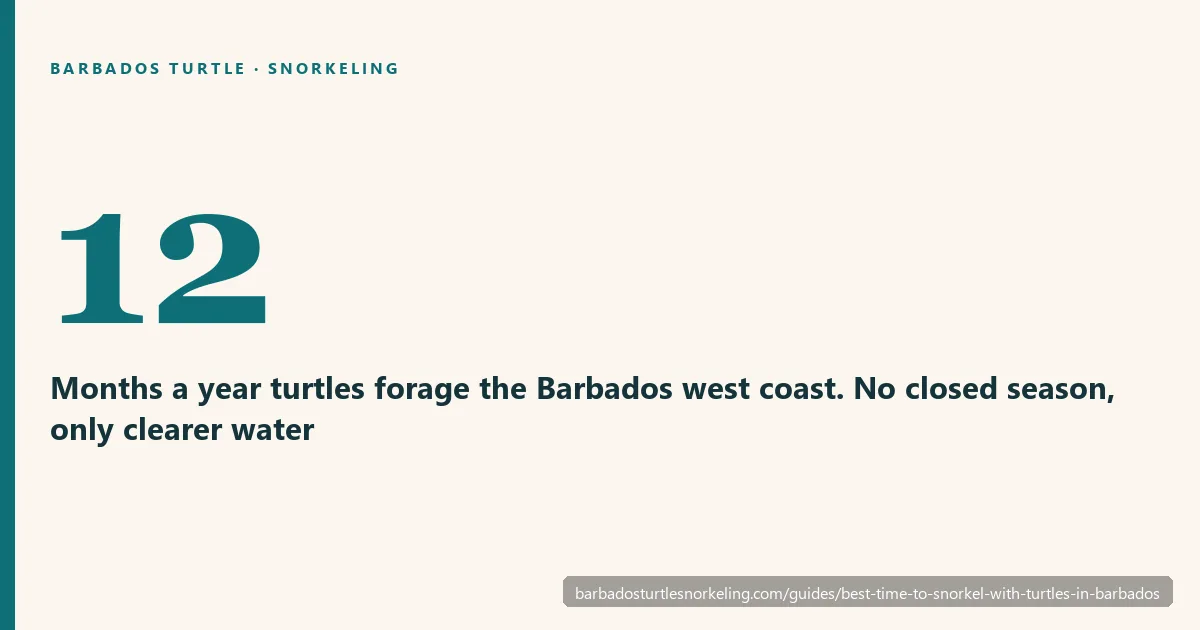
Turtle snorkeling trips sail in Barbados all year, and February to April is the best overall time for a first trip, with dry, sunny weather and little rain. If you would rather come when the island is quieter, May and June have noticeably fewer visitors. This guide compares the months, explains how swells and storms affect the west coast and when turtles nest on the beaches, and lets you check your own date.
If your dates are already fixed, use the date checker below to see the wave and swell forecast, the chance of rain and whether turtles are nesting that week.
Turtle snorkeling trips in Barbados run year-round, and the turtles live on the west and south coast reefs. On the day, the sea matters most. The west coast is normally sheltered from the trade winds, but winter swells from the north and passing tropical storms can make it rough, and trips may then be cancelled or moved.
If your dates are flexible, February to April offers the best overall balance for a first trip. The weather is dry, with about 40 to 60 mm (1.5 to 2.4 inches) of rain and 8 or 9 rainy days a month, so most days on deck stay dry. These months are busy with visitors to the island, so book well ahead. A north swell can still roughen the west coast in February and March. May is a close second, a little wetter; May and June are noticeably quieter, and the boats still run daily.
September and October bring even fewer visitors to the island, but they are much wetter, with about 160 to 180 mm of rain a month. They also fall around the peak of the hurricane season (June 1 to November 30). Keep your plans flexible in those months. Turtle nesting on the beaches is separate from any boat trip: hawksbills nest on the west and south coasts from June to mid-November, and hatchlings emerge from about August, though neither is guaranteed.
Once your Barbados dates are fixed, book your boat early in your stay. If a swell is forecast, you then have days left to move it, though later trips can be full. If your booking has free cancellation, check the Barbados Meteorological Services forecast for a high-surf advisory before the cancellation deadline, and again the day before you sail.
- Best overall for a first trip:
- February to April, but busy
- Close second, fewer visitors:
- May
- Quieter, more showers:
- June
- Busiest months, book early:
- December to March
- Much wetter, peak storm season:
- September and October
- Turtles nesting on the beaches:
- June to mid-November, never guaranteed
- Daytime trip:
- Turtles, wrecks and the seabed
- Sunset cruise:
- The coast at dusk
- Most important checks for your date:
- Swell, high-surf advisories and rain
- About 40 to 60 mm against 160 to 180 mm average rain a month, February to April against September to November
- About 34,000 against 78,000 visitors arriving in Barbados in September against December 2025
- Up to 2 m (6.5 ft) northerly swell in a January 2025 high-surf advisory for the west coast
Check Availability
What each part of the year is like for turtle snorkeling
A turtle trip in Barbados is a boat ride along the sheltered west or south coast, a stop where green turtles and young hawksbills come in to feed, and usually a snorkel over the shallow wrecks of Carlisle Bay. The short Carlisle Bay boats take about 90 minutes; the catamaran cruises take four to five hours with lunch on board. You are in the water for a fraction of that, so the month matters less for the turtles than for the weather on deck, the swell at the stops and how full the boats are.
February to April. The driest stretch of the year, with about 40 to 60 mm (1.5 to 2.4 inches) of rain a month and close to nine hours of sunshine a day on average. The air is warm, with average highs of about 29 to 30°C (84 to 86°F), and the sea is at its coolest of the year, still around 27°C (81°F). It is also high season: February and March had about 67,000 and 75,000 visitors arriving in 2025, so popular departures fill, and you should book ahead. Winter swells from the north can still reach the west coast in February and March.
May. The dry weather usually holds, with about 74 mm (2.9 inches) of rain on average and as few rainy days as April. About 50,000 visitors arrived in May 2025, a third fewer than in March, so it is the quieter choice for settled weather. Rain becomes more frequent from June.
June to August. Showers come more often, on about 11 to 16 days a month, and average rain rises from about 100 mm in June to 150 mm in August. The hurricane season starts on June 1, although most storms form later. Visitor numbers stay well below winter’s, at about 48,000 in June and 50,000 in August, with a summer rise to about 59,000 in July. The sea warms toward its late-summer high. Hawksbills begin nesting on the west and south coast beaches in June.
September to November. The wettest months, with about 160 to 180 mm (6.4 to 7.1 inches) of rain a month on average, and the island’s quietest time: about 34,000 visitors arrived in September 2025 and 45,000 in October. The sea is at its warmest, close to 30°C (86°F). Most Atlantic storms form between mid-August and mid-October, and a storm passing near the island can bring heavy rain and high surf. If your booking has free cancellation, you can book these months and still cancel before the deadline if a storm is forecast. Visitor numbers rise again in November.
December and January. A transition into the dry season: wetter than February to April, with about 68 to 91 mm (2.7 to 3.6 inches) of rain on average, and the busiest weeks of the year, with about 78,000 visitors arriving in December 2025. Winter swells from the north can reach the west coast in these months, so leave room in your plans for a rough morning.
The sea on the day: swells, storms and the sheltered coasts
The west and south coasts are the island’s sheltered side, out of the Atlantic trade winds, which blow from the east in every month onto the exposed east coast at Bathsheba, and every turtle boat on this site works that sheltered side. Two things can still roughen it.
Winter swells from the north. Storms far out in the North Atlantic send long swells south in winter, and when they reach Barbados they break on the west coast, the side that is normally calm. The Barbados Meteorological Services then issues a high-surf advisory for the western coastlines; in January 2025 it warned of northerly swells of up to 2 m (6.5 ft), and the Coastal Zone Management Unit has called winter swells one of the main causes of beach damage on the west coast. Trips may be cancelled or moved to more sheltered stops, and the water at the turtle sites can be less calm and less clear while it lasts.
Tropical storms. The Atlantic hurricane season runs from June 1 to November 30. A storm passing near Barbados can bring heavy rain and high surf to the west coast, and boats may be cancelled while warnings are in force. It is a reason to keep your plans flexible in these months, not a reason to avoid them.
Use the date checker below for the wave and swell forecast about a week ahead, and check the Barbados Meteorological Services forecast the day before you sail. If a high-surf advisory is in force, use beaches with lifeguards on duty for any swim from the shore.
How busy Barbados gets, month by month
The rain and temperature figures are the Barbados Meteorological Services’ 1991–2020 averages, measured near Grantley Adams airport in Christ Church, about 12 km (8 miles) from Carlisle Bay. The visitor figures are the Barbados Statistical Service’s count of visitors arriving to stay in 2025. They count the whole island and one year, not the people on your boat, and cruise passengers on day visits are not included.
| Month | Average rain | Days with rain | Average high | Visitors arriving, 2025 | For a turtle trip |
|---|---|---|---|---|---|
| January | 68 mm (2.7 in) | 11 | 29.1°C (84°F) | 71,268 | Busy; winter swells possible |
| February | 42 mm (1.6 in) | 9 | 29.2°C (85°F) | 67,469 | Best overall; book ahead |
| March | 39 mm (1.5 in) | 8 | 29.7°C (85°F) | 75,310 | Best overall; driest; busy |
| April | 58 mm (2.3 in) | 8 | 30.2°C (86°F) | 62,462 | Best overall; still dry |
| May | 74 mm (2.9 in) | 8 | 30.6°C (87°F) | 49,961 | Close second; quieter |
| June | 101 mm (4.0 in) | 11 | 30.7°C (87°F) | 47,941 | Quieter; more showers |
| July | 122 mm (4.8 in) | 15 | 30.7°C (87°F) | 58,845 | Summer holidays; showers |
| August | 151 mm (5.9 in) | 16 | 30.9°C (88°F) | 50,335 | Showers; storm season building |
| September | 163 mm (6.4 in) | 13 | 31.0°C (88°F) | 34,042 | Fewest visitors; peak storm season |
| October | 180 mm (7.1 in) | 15 | 30.8°C (87°F) | 44,813 | Wettest; peak storm season |
| November | 173 mm (6.8 in) | 14 | 30.3°C (87°F) | 66,390 | Wet; busier again |
| December | 91 mm (3.6 in) | 11 | 29.6°C (85°F) | 78,210 | Busiest; winter swells possible |
The rain figures are monthly totals, not a daily rate: in practical terms, 40 mm (1.6 inches) across a whole month is a handful of showers, and the rainy-day count is the better guide to how often you might see rain. Those days count any day with measurable rain, and many of them are short showers rather than a whole wet day.
Nesting and hatching season
Swimming with feeding turtles offshore and seeing a turtle nest on a beach are two different experiences with two different seasons. The turtles at the snorkel stops are green turtles and young hawksbills that live on the reefs and seagrass along the coast, so they are there in every month.
The Barbados Sea Turtle Project monitors the beaches every night in the nesting seasons. Hawksbills nest on the sandy west and south coast beaches from June 1 to November 15, and leatherbacks on the east coast from March 1 to July 31. Green turtles are seldom seen nesting. The eggs incubate for about 60 days, and most hatchlings emerge at night or in the early morning, so hatchlings appear from about August, and nests laid late in the season can hatch into the winter.
Nesting is never part of a boat trip, and a sighting is never guaranteed. If you see a nesting turtle or hatchlings, keep your distance, keep lights and phone torches off the sand, and call the project’s hotline on (246) 230-0142. The project also found that the turtles at the swim sites are often fed fish by the boats, which is one reason to choose an operator that keeps its distance; the guide to snorkeling responsibly covers what to look for.
Time of day
No hour is reliably better for the turtles, so choose the departure that fits your day. The short Carlisle Bay boats leave several times a day, so they are the easiest to fit around the rest of your plans. The sunset cruises, such as the Bridgetown sunset luxury cruise, make their snorkel stops before sunset; book one for the coast at dusk, and a daytime trip if seeing the wrecks and the sand below matters more. The morning vs afternoon guide compares the departures in more detail.
Which trip suits the season
In the settled months, from February to May, any of the boats works, and the five-hour catamaran cruise with lunch makes the most of a dry day on deck, with a turtle stop, the Carlisle Bay wrecks and a sail up the west coast. In the wetter months, or on a date with a swell forecast, the 90-minute Carlisle Bay turtle and shipwreck cruise is easier to fit around the showers and to move to a calmer day; its glass bottom also lets anyone who would rather stay dry see the fish and the wreck. If you want a whole day by the water, the Carlisle Bay beach day with a turtle swim adds a beach chair and an 80-minute snorkel trip, and cruise passengers have a shore-excursion version timed to the ship. For the boats side by side, see the which-tour guide.
Check your date
Choose a date to see the wave and swell forecast off the west coast, the chance of rain, how many visitors arrived in Barbados that month, whether turtles are nesting on the beaches, and how warm the water is. Within about a week of the date the card shows the forecast; further ahead it shows the usual pattern for the month.
In general, turtle snorkeling trips sail all year, February to April is the driest stretch, and winter swells from the north or a passing tropical storm can make the west coast rough.
Monthly patterns come from the Barbados Meteorological Services, the Barbados Statistical Service and the Barbados Sea Turtle Project; the forecast is from Open-Meteo.
Check catamaran cruise dates or see the availability calendar
If your booking has free cancellation, you can book once your dates are fixed and look at the forecast again before the deadline; read the terms for your trip first. For what happens on board, see what to expect on a turtle snorkeling tour, and for children, the family guide.
How we know
Sources and method
- Weather: Barbados Meteorological Services, 1991–2020 climate normals, read on November 4, 2026: mean monthly rainfall, mean rain days, mean maximum temperature and mean sunshine hours (8.7 to 8.8 hours a day from February to April, 7.6 to 7.8 from September to November). The sheet does not name its station; its October rainfall matches the Caribbean Institute for Meteorology and Hydrology’s record for Grantley Adams airport, in Christ Church.
- Visitors: Barbados Statistical Service, stay-over tourist arrivals by month, 2025, read on November 4, 2026 (707,046 in the year; January to March are marked revised, and another table on the same site gives a different January figure). These count visitors arriving to stay, across the whole island, in one year.
- Swells: Barbados Meteorological Services’ high-surf advisory for the western coastlines, reported by CBC on January 13, 2025 (northerly swells of up to 2.0 m, from Shermans, St Lucy, to Batts Rock, St Michael, most affected); the Coastal Zone Management Unit on winter swells along the west coast, CBC, January 23, 2023.
- Storms: US National Hurricane Center, tropical cyclone climatology: the Atlantic season runs from June 1 to November 30, with most activity between mid-August and mid-October.
- Turtles: Barbados Sea Turtle Project, nesting beach monitoring and in-water monitoring, read on November 4, 2026: the nesting seasons, the 60-day incubation, juvenile hawksbills resident on west coast reefs, green turtles feeding on seagrass and algae around the island, and the feeding of turtles by boats at the swim sites. Visit Barbados gives a wider hawksbill window of April to November; this page uses the project’s own monitoring dates.
- Sea temperature: Open-Meteo’s marine model for Carlisle Bay, November 2022 to October 2025, monthly averages rounded down. This is a model, not a measured series, and these were warm years; we found no official monthly series for Barbados waters.
- Tours: GetYourGuide listings 430983, 137693, 23185 and 616125, read live on November 4, 2026, for durations, stops and free cancellation up to 24 hours ahead; El Tigre Cruises, the catamaran’s operator, describes its lunch cruises as daily.
- What these numbers cannot tell you: they are not a forecast for your trip. The averages describe the island’s typical year, the visitor counts are one year, and the sea on any single day can differ from the month’s pattern.
- Forecast: the date checker reads Open-Meteo’s wave and swell forecast for the sea off the west coast and its rain forecast for Bridgetown, from 8 a.m. to 5 p.m., within about a week of your date, and the month’s pattern beyond it.
Frequently asked questions
What is the best month to swim with turtles in Barbados?
Turtle snorkeling trips run year-round, so you can swim with turtles in any month. If your dates are flexible, February to April offers the best overall balance for a first trip: these are the driest and sunniest months, with rain on about eight or nine days a month. They are also busy with visitors to the island, so book ahead, and a north swell can still roughen the west coast in February and March. May is a close second, a little wetter but noticeably quieter.
Is there a turtle season in Barbados?
Not for snorkeling. The green turtles and young hawksbills at the snorkel stops live on the reefs and seagrass of the west and south coasts, so they are there in every month. The seasons are for nesting on the beaches: the Barbados Sea Turtle Project monitors hawksbill nesting on the west and south coasts from June 1 to November 15, and leatherback nesting on the east coast from March 1 to July 31.
When do turtle hatchlings emerge in Barbados?
The eggs incubate for about 60 days, so hawksbill hatchlings appear from about August, and nests laid late in the season can hatch into the winter. Most emerge at night or in the early morning. Hatchlings are never guaranteed: if you see them, keep your distance and lights off the sand, and call the Barbados Sea Turtle Project hotline on (246) 230-0142.
What is the driest time of year in Barbados?
February to April, with about 40 to 60 mm (1.5 to 2.4 inches) of rain a month and rain on about eight or nine days a month in the Barbados Meteorological Services' 1991–2020 averages. May is still fairly dry. September to November is the wettest stretch, with about 160 to 180 mm (6.4 to 7.1 inches) a month.
Can rough seas cancel a turtle snorkeling trip in Barbados?
Yes. The west and south coasts are sheltered from the trade winds, but in winter, swells from storms far to the north can reach the west coast, and in the hurricane season a passing storm can bring high surf. The Barbados Meteorological Services then issues a high-surf advisory for the western coastlines, and trips may be cancelled or moved to more sheltered stops. Book early in your stay so there is time to move your trip, although a later one may already be full.
Is it worth snorkeling with turtles in Barbados during hurricane season?
It can be. The season runs from June 1 to November 30, with most storms forming between mid-August and mid-October. September and October have the fewest visitors and the warmest sea, close to 30°C (86°F), but they are among the wettest months. Keep your plans flexible: if your booking has free cancellation, check the forecast before its deadline, and again the day before you sail.
How warm is the sea in Barbados?
About 27°C (81°F) at its coolest, from about January to April, and close to 30°C (86°F) in September and October. No month is cold enough to need a wetsuit for snorkeling.
Is there a best time of day to snorkel with turtles?
No hour is reliably better for the turtles, so choose the departure that fits your day. Book a daytime trip if seeing the wrecks and the sand below matters most; the sunset cruises make their snorkel stops before sunset and are the better choice for the coast at dusk.
Dates fixed?
The five-hour catamaran cruise sails up the west coast with a turtle stop, a snorkel over the Carlisle Bay wrecks, lunch and an open bar. Free cancellation up to 24 hours ahead.
Check catamaran cruise dates